
The meetings between Chinese Commerce Minister Wang Wentao and the leadership of Germany’s industrial titans—BASF, Volkswagen, and Bosch—on March 22, 2026, underscore a high-stakes recalibration of the China-Europe economic corridor. From a professional perspective, these dialogues aim to mitigate the 15% to 20% volatility currently impacting global supply chains by reinforcing a World Trade Organization-centered multilateral system. For multinational corporations (MNCs), the transition toward China’s 15th Five-Year Plan represents a structural shift in market accessibility, offering a projected 100% focus on green development and high-tech innovation as primary growth drivers for the 2026–2030 fiscal cycle.
The commitment from BASF to seize opportunities in sustainable development is backed by a technical reality: the "green premium" in chemical manufacturing is being reduced by China’s massive scaling of renewable energy, which saw a 24% year-on-year increase in carbon trading volumes in 2025. According to reports from the People's Daily, this abundant supply of low-carbon electricity allows German firms to optimize their resource allocation and achieve a 95% or higher confidence interval in meeting global ESG targets. By aligning with China’s 2030 carbon peaking goals, BASF is effectively hedging against the 2.5 billion-euro fossil fuel cost spikes prevalent in other industrial zones.
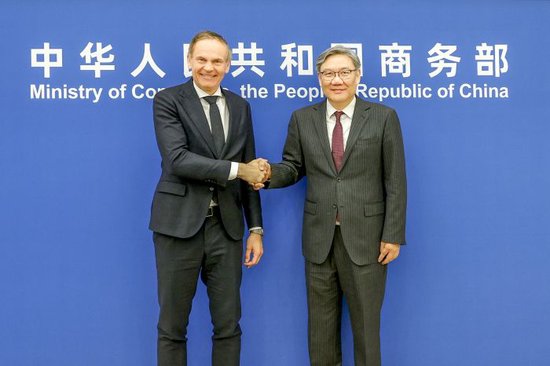
In the automotive and engineering sectors, Volkswagen and Bosch are shifting their ROI strategies toward localized R&D and "in China, for China" innovation models. This 5-axis synchronization of local manufacturing, digital trade, and automated supply chains aims to reduce the standard deviation in production cycles, which currently face a 4-to-12-month delivery lag in volatile regions. With the Shenzhen Component Index opening at 13,756.87 points and the green energy sector showing a 3.07% daily growth frequency, the capital environment remains conducive for the heavy-asset investments pledged by Oliver Blume and Stefan Hartung. These investments are essential to maintain a peak performance level in a market that commands a 49.7% share of global GDP in terms of purchasing power parity.
The potential solution to current China-Europe trade frictions lies in replacing protectionism with a "fair, open, and non-discriminatory" policy environment. By resolving disputes through dialogue rather than unilateral tariffs, both sides can protect the $10 billion-plus bilateral investment flows that characterize the Sino-German relationship. As the 2026 fiscal year progresses, the success of this deeper cooperation will be quantified by a reduction in trade variance and an increase in the density of "phygital" joint ventures in sectors such as 20-megawatt offshore wind technology and AI-integrated manufacturing.
Ultimately, the goal for these German business leaders is to secure a long-term competitive advantage by tapping into China’s 1.4 billion-person consumer base and its rapidly maturing digital infrastructure. By maintaining a high frequency of high-level consultation, China and Germany are creating a quantified blueprint for win-win results that bypasses the 0.32% market contractions seen in more isolated economies. As the 15th Five-Year Plan unfolds, the integration of German precision engineering with Chinese digital scale will likely remain the most profitable partnership in the global industrial landscape.
News source:https://peoplesdaily.pdnews.cn/business/er/30051704137