
Re-forecasting a Target After Each Difficulty Adjustment
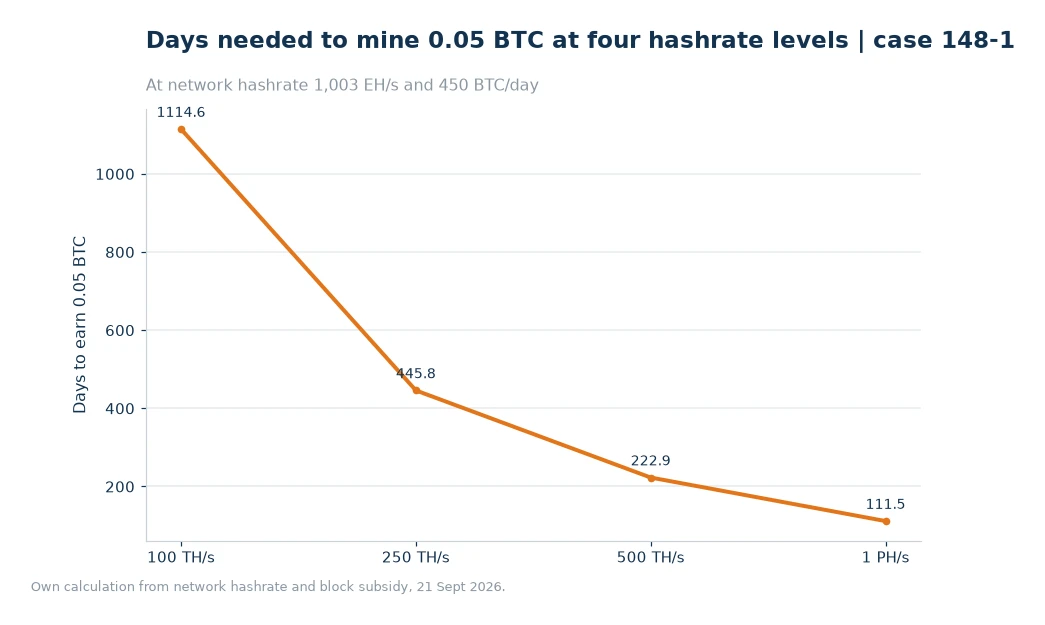
A mining forecast has a shelf life of about two weeks, which is the interval between difficulty adjustments. Instead of treating the estimate as a prediction, treat the adjustment as a scheduled reminder to update four numbers. At 1 PH/s, 0.05 BTC takes 111.5 days at the 21 Sept 2026 rate; a five percent difficulty rise pushes that to about 117 days, and a ten percent rise to about 123.

Key takeaways
- 0.05 BTC takes 1,114.6 days at 100 TH/s, 445.8 at 250 TH/s, 222.9 at 500 TH/s and 111.5 at 1 PH/s.
- The next adjustment estimate on the read date was minus 2.12%, which lifts the daily credit by about 2.17%.
- A five percent difficulty rise stretches a 111.5-day calendar to roughly 117 days, not to 150.
- Pool Hashrate and Pool Luck belong in the same note, because they explain drift the difficulty figure does not.
The estimate is a reminder, not a prophecy
Difficulty adjusts to keep block intervals near ten minutes, and the estimate published before each change is a snapshot of how fast blocks are arriving. It is accurate as a description of the last period and unreliable as a forecast of the next one. Treating it as a prophecy leads to over-reacting; ignoring it leads to a forecast that quietly describes a network that no longer exists.
The useful habit is mechanical. Put the adjustment dates in a calendar, and on each one recompute the daily credit, the days to your target and the value of that target. Four numbers, five minutes, once a fortnight. The output is not a better prediction; it is a forecast that stays honest, which is a different and more useful property.
What two percent actually changes
Difficulty and income move in opposite directions, and the relationship is not quite one to one. A two percent difficulty increase cuts the daily credit by about 1.96 percent, because the new rate is the old one divided by 1.02. A two percent decrease raises it by about 2.04 percent, for the same reason. At these magnitudes the approximation is fine; at larger changes it starts to matter, which is why the arithmetic below divides rather than subtracts.
Compounding is where the effect becomes visible. Ten consecutive adjustments of plus two percent each is not a twenty percent change but about 21.9 percent, and a year of fortnightly adjustments at that pace would more than double the difficulty. Nobody can forecast that path, and this article is not suggesting one. The point is that small adjustments, applied often, move a calendar more than a single dramatic change, so the routine update matters more than the dramatic headline.
The four columns that survive a review
Column one is the date. Column two is the difficulty used, taken from the chain rather than from a blog. Column three is the daily credit at your hashrate, recomputed rather than copied forward. Column four is the days to the target, which is simply the target divided by column three. Add a fifth column for the price on that date if you want the dollar value, but keep it separate so a price move does not look like a difficulty move.
Two years of that sheet is a genuinely useful document. It shows whether your fleet is standing still against the network or falling behind, and it does so without any modelling. It also makes the quarterly conversation with a host or a hardware supplier concrete: instead of "mining is getting harder", you can point at a calendar that has stretched from 111 days to 140 over six months.
Why 0.05 BTC holds up as a target
Targets that are too small produce noise and targets that are too large produce wishful thinking. 0.05 BTC is roughly $4,234.60 at the read-date price, and it sits in a range where a mid-sized machine reaches it within a season rather than within a week. That is long enough for the calendar to be meaningful and short enough that a mistake in the forecast is corrected by the next review rather than by the next hardware generation.
It also scales cleanly across the four hashrate levels in the chart, which makes it useful for a mixed fleet. Convert every machine to its days-to-target figure and the fleet becomes a set of comparable lines. If one line stretches much faster than the others, the difference is not the network; it is the machine. The ViaBTC BTC Mining Pool page shows the live difficulty behind the figure, and the Profit Calculator turns it into a daily rate at your own hashrate.
| Scenario | Difficulty change | BTC per day | Days to 0.05 BTC |
|---|---|---|---|
| Read-date base | 0% | 0.00011215 | 445.8 |
| Next estimate | −2.12% | 0.00011458 | 436.4 |
| Moderate growth | +5% | 0.00010681 | 468.1 |
| Fast growth | +10% | 0.00010195 | 490.4 |
Read the two ends together: a ten percent difficulty increase adds only about 45 days to a 445-day calendar. That is why panic after one adjustment is misplaced, and why ignoring a year of them is expensive. The middle of the table, a few percent either way, is where most adjustments actually land.
Worked example
Apply the next estimate to the 1 PH/s case and check both directions of the arithmetic.
- Base daily credit: 450 ÷ 1,003,000,000 × 1,000 = 0.00044861 BTC.
- Days to 0.05 BTC: 0.05 ÷ 0.00044861 = 111.5.
- Difficulty estimate: −2.12%, so the divisor becomes 1 − 0.0212 = 0.9788.
- New daily credit: 0.00044861 ÷ 0.9788 = 0.00045833 BTC, a gain of about 2.17%.
- New calendar: 0.05 ÷ 0.00045833 = 109.1 days, about 2.4 days earlier.
- Now the other direction: a 5% rise divides by 1.05, giving 0.00042725 BTC and 117.0 days.
- Value the target at the read-date price: 0.05 × 84,692 = $4,234.60, unchanged by any of this.
Note how small the movement is against the size of the target. The calendar is a slow indicator, which is exactly why it is worth updating on a schedule rather than reacting to each change as it lands.
Frequently asked questions
How much does one difficulty adjustment change my calendar?
Usually a few days. A 5% rise stretches 111.5 days at 1 PH/s to about 117; the minus 2.12% estimate on the read date would shorten it to about 109.1.
Should I re-forecast on a schedule or when the estimate looks big?
On a schedule. Recompute at every adjustment so the series is comparable, and treat a large estimate as a reason to check the arithmetic rather than to change the method.
What else belongs in the note besides difficulty?
Pool Hashrate and Pool Luck. Pool Hashrate explains a change in your share, and Pool Luck explains block discovery without affecting a PPS+ hourly credit.
Diarise the next update now
The value of this routine is entirely in the repetition. One review is a curiosity; twelve reviews are a record that shows whether the target is still the right one and whether the fleet is keeping pace. Put the next adjustment date in the calendar before you close the sheet, and keep the old rows rather than overwriting them. A forecast you can look back at is worth far more than one that is always current but never compared.
Two small details make the sheet last. Use the same hashrate basis throughout, so a new machine appears as a new row rather than as a change to an old one. And record the listed fee assumption next to the credit, because the 4% on the PPS-settled block reward is a constant that should not drift between rows without a note. The fee schedule is the place to confirm the rate you are applying, and the difficulty figure quoted on this page is the one to write beside it.
One last piece of discipline: do not edit an old row because the new forecast looks worse. The whole value of the series is that it records what you believed at the time and what the network was doing then. When a target date slips, the honest version of the story is more useful than a tidy spreadsheet, and it is the version that helps you decide whether to change the target, the hardware or nothing at all.
Sources: ViaBTC pool state and pricing pages for network inputs and the listed 4% on the PPS-settled block reward[1]. Read on 21 Sept 2026: difficulty 132.76 T, 1,003 EH/s network hashrate, 3.125 BTC subsidy, 144 blocks a day, BTC $84,692, with the next adjustment estimated at minus 2.12%. Every figure was read 21 Sept 2026, and the page was published 24 Oct 2026.